The following has been composed over a number of years and includes sections that have been previously shared. I still consider it a draft.
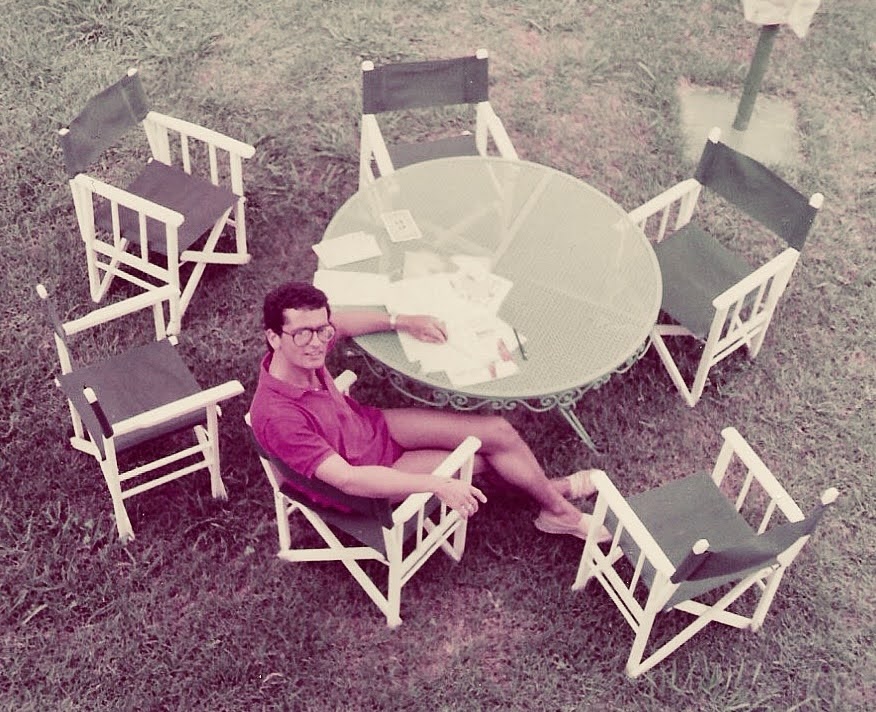
Between May and September 1983 I lived in the very posh seaside resort town of Forte dei Marmi, Italy. It was a unique experience that has lingered in my memory and been the subject of several written stories. I worked for a Florentine family that split its time between Florence and Forte dei Marmi. I had been hired to be the driver and aide to noted Florentine architect Lorenzo Papi. Papi, experiencing health issues and being heavily medicated was unable to drive himself. Beyond driving, my primary duties were to oversee the regular doses of medications prescribed, and to try to ensure that he did not have access to an over-the-counter pain medication, Optalidon, which apparently when taken in large amounts and with other medicines can cause heightened intoxication. I was combination driver-companion-spy, roles that I performed to varying degrees of success over my time with the family.
I forget the details of my interview with Lorenzo’s wife who hired me. It was springtime of 1983 and I was working as a part-time instructor at the American Institute of Language in Florence and giving private English lessons on the side. Since the prior autumn I had been living in Via Solferino in a rented room in the flat of Signora Massi. The opportunity to interview for this role came through my colleague, Patty Paganelli, the main reception and administrative support at the American Institute. Patty had taken the call from Mrs. Papi looking for a “responsible American” who could drive and be a companion–and of course she thought of me.
By the middle of May I had packed all of my things, leaving Via Solferino and Signora Massi behind, and managed to get myself to Forte dei Marmi where the Papi’s had their primary home–The Blue House–La Casa Azzurra. It turned out to be a summer full of new experiences and people and complex personalities and dynamics that have long remained with me.
The occupants of Casa Azzurra included Lorenzo Papi, his wife Donatella, and their 15 year old son, Leonardo. Ostensibly, if any nosy Italians inquired, I was also there to help Leonardo with his English. Gianna was a local woman who came daily to cook and clean for the family. The house was situated on a large plot of land that included fruit trees including at least one fig tree. The house had been designed and built by Lorenzo for his wife, probably in the early 1970s. It was two stories with large, light-filled rooms that were both sleekly modern but comfortable with an eclectic mix of furnishings and decor. While primarily white in color, the house derived its name from the signature bright blue accents that ranged from the shutters to beach towels and bedding. Lorenzo was a design architect and many pieces of furniture had been custom made based on his designs. The color blue and the wave form played a major influence in his designs.
I would try to recount some of my summer experiences without going into too much detail about my hosts and employers, but it is difficult to separate my experience from the people who shaped them. Below I will try to capture a bit of my impression, through a filtered lense of 35 years, of the primary players in my summertime adventure. There are memories centered on each one that stayed with me and as such have clearly changed me. As I mentioned above, theirs is a complex story made even more complicated by intellectual and creative sensitivity and substance abuse. I can say that I still feel a deep and profound fondness for all of the primary players–they were or are good people doing the best they could in trying circumstances.
The rhythm of my day during this period was shaped by the schedule of my charge, Lorenzo. One side effect of the medication he was on was that he would go to bed early and get up late. My early morning hours were mostly at my own leisure which would include breakfast and perhaps a walk, a bike ride, or reading in the back garden. I had plenty of time to prepare the morning dosage to give to Lorenzo when he woke up.
More often than not, after his morning coffee and pills, he would want to drive to the beach and we would make the five minute trip to Bagno Dalia where the family rented a changing cabin and an “ombrellone” and chaise lounge for the season. The Bagno Dalia was a lovely place, very well cared for with the property all clean and tidy each morning before the flood of beach goers descended for the day. We were generally among the first to arrive while the day was still its most fresh. Like so many Italians who love their sun, Lorenzo, in spite of his overall unhealthy state, did manage to maintain that deep tan that seems cherished by Italians. At that time of my life I don’t think I had managed yet to tan without first suffering the discomfort of a painful burn. I don’t know why or how but one outcome of my summer job was deepest tan of my life.
Conversations with Lorenzo were interesting and challenging. He was an incredibly intellectual and artistic person. He had, up until his current illness, been extremely successful as an architect and designer. He spoke English very fluently and had traveled to many parts of the world. The challenging aspect came more due to the rather rambling nature of his thought process combined with a tendency to slur his speech as an effect of his medication. Looking back on this time, I am now more than several years older than Lorenzo was in 1983. My twenty-three year old self admired many aspects of the man but felt sorry for him based on his current living conditions. Over the course of the summer I witnessed and experienced more of the self-destructive aspect of his condition and its impact on the people who loved him most.
After a morning of sunbathing we would often head home between one and two to find lunch prepared for us by Gianna. Lunch generally would include Lorenzo and 15 year old Leonardo and less often, Donatella, their wife and mother respectively. Lorenzo took full advantage of the stereotypical post-lunch “sosta”, napping for an hour or two after lunch. Again, my time was my own to squander and sometimes I would return to the beach, sometimes with Leonardo, sometimes on my own. I also made good use of the two house bikes that were on hand. I recall one was black and the other white, one with a basket and the other without. When not otherwise needed at the house I would take a bike and ride. Sometimes I would ride randomly up and down the long shaded roads that ran perpendicular to the ocean and then back and forth on the cross streets. When I first arrived in May these roads were often solitary and quiet; later, in July and August, the roads were more active with cars and bikes as more and more families came and opened up seasonal vacation homes.
I recall that there was an evening dosage for Lorenzo that I would need to have ready by the time he got up from his nap. After this it wasn’t uncommon for Lorenzo to want to run an errand–pick up a new magazine or buy a specific chocolate, or some fruit he was craving. We would dash about town to do these errands in a Citroen Mehari that I equate to driving a giant toy car around. The Mehari is a very boxy utilitarian vehicle and this particular one had removable components including I suspect, the windshield. As the weather grew warmer we simply removed different panels. The stick shift was a straight shaft coming out of the dashboard with very little flourish or adornment. It sounded a bit like a riding lawn mower but was fun and easy to drive and maneuver. Wherever we went, the village being small and the family being year-round residents, Lorenzo and his idiosyncrasies were well known.
On our very first outing together, I believe on my very first day, we were driving to the center of the village for a Sunday passeggiata, when I saw a silver haired man riding his bicycle going our direction. Around his shoulders he was wearing a sweater emblazoned with the eagle emblem of the Italian designer Giorgio Armani. As we approached I jokingly said to Lorenzo, “Guarda, eccolo Giorgio Armani” (Look, there he is, it’s Giorgio Armani). As we passed I glanced in the rearview mirror and realized that it really was the famous designer!
When we parked the car, Lorenzo made a beeline directly to the town’s main outdoor cafe with the express intent to introduce himself to Giorgio Armani. Without hesitation Lorenzo introduced himself and chatted a bit about his admiration and then very politely introduced me as “un amico americano”. I shook hands and politely responded “molto piacere” (very pleased to meet you). Unfortunately that was the only time that we crossed paths with Mr. Armani that summer and I was not plucked from obscurity to become the next top Armani model. Sigh, likely just as well.
Lorenzo
Lorenzo Papi was the second born, and only son, of four children of Elena Vittoria (Vittorina) Contini Bonacossi and Roberto Papi. His grandparents were the Contini Bonacossis whose extensive art collection would be the focus of much controversy. He and his sisters undoubtedly enjoyed a very privileged life as heirs to a vast fortune, not least of which was a world-renowned collection of masterworks of art. Lorenzo’s father, Roberto Papi was a poet who was well connected in literary and artistic circles. The American author Mary McCarthy dedicated her book “The Stones of Florence” to him. It seems that years later, Roberto Papi’s connection to American poet and publisher Stanley Moss would factor into the controversy that grew out of the Contini Bonacossi collection.
After completing his degree in architecture, Lorenzo spent time in the USA working with famed engineer and architect Pier Luigi Nervi. While I am not sure of the timing, I believe this would be in the mid-to-late 1950’s or early 1960’s. When he returned to Florence he founded the firm “Forte 63” with colleagues Giancarlo Nocentini, Niccolo’ Rucellai and Bruno Sacchi. Collectively the firm and partners achieved great success. I believe their offices were located in the ex-limonaia of the Palazzo Gino Capponi, a 17th century building owned by the Contini Bonacossi before being sold as condominiums. I had the opportunity to stay there for several weeks that summer.
Along with professional success during this period, Lorenzo married Donatella Turini and by 1967 they had their son and only child, Leonardo. It was for Donatella that Lorenzo designed and built the Casa Azzurra at Forte dei Marmi. From what I recall from conversations with Lorenzo and seeing plans and photos of buildings he had realized as an architect, he was in the prime of his profession with projects and commissions all over the world. He was also productive as a designer and author with collaborations with Alvar Aalto, Mies van der Rohe, and Marino Marini. From all outward appearances it seemed that Lorenzo’s creativity and ambition had achieved great financial, professional, and personal success.
The Contini Bonacossi Collection
Sometime between 1969 and 1979 fissures began to appear in the foundation of Lorenzo’s world and in turn the world of his wife and child. While some dates and details are easy to verify, other elements of the story rely on connecting random dots. The Contini Bonacossi collection was amassed over the lifetime of the patriarch, Alessandro Contini Bonacossi and his wife Vittoria. Alessandro died in 1955 and it was then that the complexities of the extensive art collection and its distribution to the Italian State began. While the collection was willed to the Italian State, there must have been many complicated stipulations because from what I can tell the government did not take possession of the collection until 1969. Apparently there was some proviso that allowed the family to liquidate pieces from the collection under the guidance of a curator. At some point issues were raised about the neutrality and legality of the curated pieces and there were accusations that some members of the heirs had underhandedly benefited by the illegal sale and export of priceless works of art. Caught up in this legal fiasco was Lorenzo Papi, whose highly strung creative sensibility was tried and tested by the shadow of scandal and innuendo.
While I am certain there were other factors at play, such as the death of his father in 1976, by 1983 Lorenzo’s health both physically and emotionally had declined dramatically. Until my time with the family, I believe that Donatella had managed and overseen Lorenzo’s situation with varying degrees of success. There were periods of stability followed by periods of erratic behavior and self-medication.
Donatella
Over the past 35 years I have told the stories from the summer of 1983 periodically. I have always used the word “ferocious” to describe Donatella Papi. If there are any negative connotations to the word, I hope I can dissuade anyone that no such intent is meant. I first met Donatella in the conference room at the Studio Forte 63 office in the limonaia of the Palazzo Capponi. She was at the time an imposing woman, likely in her mid-to-late forties. She wore her hair short in a style that I still consider quintessentially Florentine–with blond highlights over what was naturally honey blond hair to begin with. She wore exquisitely styled if somewhat matronly clothes and had that deeply tanned skin that sets off the warmth of 18K gold jewelry. She spoke perfect English with the best possible amount of Italian accent and she was direct and to the point about the situation she was looking to fill. While some people may have been put off by her direct approach, I immediately saw her as a woman who by circumstances found it necessary to take action to protect the health and well-being of a man she had committed to care for and the son that they both cherished. I call her ferocious with tremendous admiration for the strength and grace she exhibited in a very challenging situation.
Over the course of the summer I had the pleasure of meeting both her mother and her sister. The latter will be the subject of greater detail to follow. Her mother was American by birth and had married an Italian man and raised her family in Italy. She was a very lovely older lady when she visited, very proper and poised. In 1983 she was likely in her seventies. I wish I had learned more about her history–how she came to meet and marry an Italian, and how she raised her daughters in Italy. Given the era in which she raised her daughters, it should not be a surprise that they both ended up marrying into families of significant wealth.
Leonardo
To imagine 15 year old Leonardo Papi, it helps if you have had or known a puppy of a large breed of dog. Full of energy and affection, a bit clumsy and awkward in tight places but overall a good and decent teen. That age is a challenge for most–the precipice of adulthood with hormones raging and moods swinging between defiance and devotion. While I have no experience being one, I imagine that being an only child, and an only son, especially in the Italian culture, added some pressure and heightened expectations from his parents. I saw first hand a sullen, frustrated kid ignoring his parents as well as an emotionally open and expressive child fiercely loyal to both parents, sometimes in the course of a single day.
Leonardo came to refer to me affectionately as “Il grande Teemoti” or “Il grande Ogan” (the latter with an emphasis on the absence of the aitch). Affable and friendly with me, I knew that he was aware of the tension between his parents resulting from his father’s condition. It was probably for the best that he was in summer school for much of that year. Leo was probably a bit young for his age and I understood that his performance in school was not acceptable and the consequence of that was to go to summer school.
Of this entire entourage of characters I think of Leonardo the most and hope that he managed to make it into adulthood successfully and productively.
The Countess (La contessa)
One regular visitor to the house that summer was Donatella Papi’s sister Alessandra De’Micheli–or as Donatella referred to her, la contessa in the third person, and Sandra directly. Sandra was the ex-wife of Count Danilo De’Micheli but did not seem to me to be the sort to play up the title. Afterall, Italian titles I believe at one time came with a hefty price tag. While Donatella’s tone when referencing la contessa was not completely without sarcasm, from what I could tell, Sandra was a down-to-earth person without airs or pretensions.
She visited us at Forte dei Marmi at least twice if not more during the summer of 1983. She, like me, was an early riser–by the standards of the household–and on more than one occasion we would each take a bike after morning coffee and have a nice ride up and down the long quiet shady roads before the heat of summer descended on the house. Having her there was a good thing for me because as a family member she was familiar with the details and privy to the complex dynamics between wife-husband-son and mother-father-son. While I do not recall discussing things in detail, I did feel relief that I did not need to be as guarded with her as with outsiders. It was later in the summer that I learned more about her own contribution to the tension.
During one period Lorenzo and I traveled back to Florence and stayed several nights at an apartment that was located on the property of la contessa’s family home. I believe it was in the Bagno a Ripoli area of Florence–an area with unattached homes and space for gardens. I only have vague memories of the purpose for the trip and what we did during our stay. I do recall the apartment being on the second level of the building and that it had a terrace with a view of Florence. Beyond the sloping hillside descending below the house one could see the iconic Duomo and other distinguishable towers of the city. During this visit I met three or four of Sandra’s children, an older daughter who was a favorite of Leonardo’s along with at least two sons, Guglielmo and Marco.
The Countess De’Micheli died in 2008, 25 years after I met her. While I did enjoy her company during her visits to the house in Forte dei Marmi, before I left I did learn additional context regarding her contribution to the tension. I do not recall the context or what prompted Donatella to share the information, but it seems that at some point in the past, Lorenzo and Sandra had had a brief affair. Without going into detail of the affair, Donatella did speak of the difficulty of forgiving both parties. The human capacity for forgiveness is something that intrigues and mystifies me, especially in complex relationships. What I remember most is Donatella telling me that it was easier to forgive Lorenzo than it was to forgive Sandra–to paraphrase, he was a man that she had known for 20 years; as her sister she and Sandra had known each other their entire lives and she felt that that relationship merited a higher threshold of betrayal and forgiveness.
The Landi: Mother and Daughter
The story of the Landi, Alberta and Barbara, is perhaps the perfect comic relief which links the earlier part of my year in Florence to my summer of 1983 and the complexity of being in but not of a high stress environment. When I first arrived in Florence I heard through some source that an American English language school was hiring instructors. I found my way to The American Institute which was run by an American ex-patriot named Lola Jacobson. Lola was a no nonsense sort of woman who in 1982 was likely in her mid- to late-fifties and whose overall presence brought to mind shades of beige and gray. There is, or at least was at the time, a certain style of Italian elegance that was almost painfully understated. Imagine the finest Italian leather made into the most sensible and non-descript shoes you have ever seen. Florence has a long history of producing fine woolen fabric in rich and fashionable colors. Somehow Lola managed to find the most sensible pieces in the color palette ranging from drab to drabbest. While it may be a trick of my memory, I believe she wore a knee brace or ace bandage under her support hose. Another thing I remember about Lola was that she followed a macrobiotic diet–so even with all the wonders of Italian cuisine available, she was somehow able to take the joy out of eating.
I cannot begin to imagine the circumstances that inspired Lola Jacobson to leave the confines of some small town in the heartland of the USA. It seems far-fetched to think a torrid love affair with a dashing Italian would have enticed her to establish herself in Florence of all places. I cannot imagine many places that are more perfect to inspire passionate exuberance for life and beauty and art and culture. None of that exuberance was blatantly visible in the demeanor or behavior of Lola Jacobson.
Lola’s business practice was such as to become a proving ground for the starry-eyed study abroad alum who returned with adventure and romance as their goal. She regularly hired more instructors than there was demand for, resulting in part-time work for many. Part of her induction to new instructors was to admonish them with the sage wisdom, “You can’t live full time on part time pay.” It did not take me long to figure out that based on what she charged her incoming clients versus what she paid her part-time staff, that with what she paid, one would be hard pressed to live part time on full time pay.
As it turned out, I was hired that autumn on a very part-time basis. My first term I was assigned a small intermediate class and a couple of private lesson clients. Keeping in mind that in the early 1980s the Italian lira was in use. At the time, $1 USD was equivalent to about £1000. With that in mind, realizing that the American Institute charged private lesson students perhaps £35,000-50,000 per hour while paying the instructor something like £5000 per hour. It did not take long to realize that private lessons held outside the walls of the Institute would be more lucrative to the instructor and more affordable to the student. But, at the time I considered myself lucky to be employed and able to earn anything that would delay the depletion of my savings on which I relied.
My class at the American Institute consisted of six women ranging in age from twenty-something to forty-something. The fact that three of the women were related was the number one factor that shaped and influenced the classroom atmosphere. If I could, I would reach out to the three whose names have been forgotten and apologize for letting the other three dominate the classroom. Three of the women were hardworking women who sought to improve their English skills to better their work opportunities. Three of the women were women of privilege who wanted to improve their English because it was fashionable. The latter three were Alberta Landi, her daughter Barbara, and Cristina Pelu, the sister of Alberta’s husband Luigi. Alberta and Barbara were to become known to me as I Landi (the Landis).
Alberta and Cristina were very fine examples of an upper middle class Florentine housewife. They were always dressed in the finest clothes, expensive shoes and purses, and of course plenty of chunky gold jewelry which was in vogue at the time. With the Gucci, Fendi, and Valentino labels on display, I am certain the gold was verified 18K and that the pearls and stones were real. Both were in their mid-to-late forties at the time, slender and well-groomed and elegant. To say that describing Alberta’s daughter Barbara was a horse of a different color would be true and appropriate on many levels. If charm and poise were hereditary traits I would have to assume that Barbara had inherited the recessive gene from both her parents.
La Scopa Vestita
“The dressed broom” is a euphemism for an unattractive woman, in this case, really an unattractive girl, Barbara Landi. Her body was painfully angular with shoulders, elbows, and knees providing a stark backdrop for her other features. Unfortunately, they did nothing to soften the overall picture. Her lank mouse-brown hair with dishwater highlights and a patchy, pallid complexion created a monochromatic presence that was easy to overlook. In such cases personality often compensates in matters of personal appearance; had she been vivacious and charming and kind, one would have wanted to see past the superficial exterior. As it was, when Barbara did open her mouth, instead of wit, charm, sophistication, or kindness, one noticed the handful of crooked, discolored teeth that seemed to have been placed at random. At nineteen Barbara exhibited the full-blown promise of becoming an even less attractive woman.
The father of Barbara and the husband of Alberta was a man named Luigi Landi. It turns out that in their youth, Lorenzo Papi and Luigi Landi had been at school together. While one had pursued architecture and design and the other was a banker and insurance professional. So, while they were acquainted and in overlapping social circles, they were not close friends.
As it turned out, while I only taught the Landi/Pelu trio for a single term, because I did continue to visit the American Institute for private lessons and to keep in touch with my colleagues and friends, I did upon occasion bump into Alberta and Cristina as they were coming or going from their continued courses in English.
In the spring of 1983, what would have been my third quarter teaching at the language institute, I discovered I could get by on private tutoring sessions. By chance I had stopped by to visit my former colleagues and friends just as the Level 3 class was ending. “Ciao, Teem, how are you?” I turned to see Christina and Alberta in all their sophistication. I had just said goodbye to the receptionist who was busy with the change of classes and was leaving at the same time as my former students. We exited the school under the 19th century colonnade into the crisp early-spring sunshine. The brightness of the day was augmented by the effect of the sun on the gold and ochre tones of the buildings. The colonnade, usually full of vendors and strollers, was made even more intimate by the addition of thousands of flowering plants, part of the annual flower and garden show. Huge shiny green ficuses, delicate, vibrant azaleas and rhododendrons, and fragrant blossoming orange and lemon trees had all appeared overnight as if by magic. The ladies and I joined the throng in the typical Florentine style, a slow, leisurely stroll as if alone in the world, a sort of dance with others crisscrossing paths while still moving fluidly at our own pace. It was difficult enough for me to communicate in Italian so amid the din of the street I had to stay close by, lean intently, and strain to hear and comprehend the murmuring of the sisters-in-law. I am certain that on more than one occasion we took each other by the elbow to facilitate our communication. Linking arms in a crowd is commonplace in that world. It didn’t occur to me at the time but in hindsight I realize that it was primarily with Alberta that I was conversing in quiet, whispered, conspiratorial tones. Christina was often off ahead or behind us admiring a display or poking among the forest of potted plants.
Our meandering took us blindly through the Piazza della Repubblica, along via Porta Rossa and into the Piazza della Signoria where we finally said goodbye in the shadow of the Loggia dei Lanzi. They had an appointment to keep and I was relieved as I had begun to weary of both the conversing and pretending to not notice Alberta’s flirting, which seemed more apparent when Christina was a few steps away. Her final gesture before leaving me that beautiful spring morning was to hand me a sprig of orange blossom while kissing me on both cheeks, as is the Italian custom.
It must have been on one such occasion that I shared with Alberta and Cristina the news that I had taken a new position and would be moving to Forte Dei Marmi. I don’t recall the details but I can’t imagine being indiscreet about my position duties. I may have implied that I would be helping Leonardo Papi with his English. Regardless of the details, it was this way that I discovered that the families were known to each other and that Alberta and Luigi Landi’s summer home was in a resort town next to Forte dei Marmi.
That first devious call for me, followed by others, made it difficult to explain to Donatella and Leonardo why Barbara Landi kept calling me. Each call, like the first, was just a smokescreen to pass the phone to Alberta. Barbara Landi would call the Papis and ask for me. As soon as I answered, she would promptly say, “Ti passero alla mama” and just like that I would be having an “innocent” conversation with Alberta Landi. After putting it off as long as possible, I set up the first of many clandestine meetings that would take place over the rest of the summer. On Alberta’s part there was much assumption that I was fully cognizant of why she was calling and what it meant. I shielded my amazement and feigned naiveté and agreed to meet her. So the assignation was set and so too were the machinations of an affair that would never be.
My days with the Papi family at Casa Azzurra were pretty relaxed, giving me time to enjoy the morning, taking my coffee and breakfast and often a bike ride up and down the long, quiet roads lined with umbrella pines and thick hedges. Even during the height of the season, these morning rides were quiet and undisturbed. Behind the thick hedges and locked gates were the vehicles that in the evening and on the weekends would clog the roads. It seemed the local populace were keen on sleeping late even on bright cheery summer mornings. By the time I returned from my ride it would be time to supervise the morning regimen and pack up to go to the beach. Each day was like clockwork and afforded me several periods of time to myself, alone to write or read, to run errands, or, as the case may be, meet someone clandestinely.
Each Wednesday morning, in the village center, there was a dusty little park that hosted an open market. The market stalls formed a circle around the perimeter of the nondescript little park. The wares being sold were no more notable than the park itself, so the two combined made a drab yet garish backdrop for my first date with Alberta. She had selected this place and time so as to be inconspicuous amongst the summertime crowds poking and browsing through the market should any of her well-heeled peers chance to spy her in my company. It would make for a credible setting for a “coincidental” meeting with her former teacher. I thought I was nervous waiting for her, a hollow, jumpy sensation reaching up from deep within, but it pales in comparison to the surrealism of the actual encounter.
I saw her approaching and the hustle and bustle of the summer market slowed to a dreamlike slow motion sequence from a film. She was dressed in linen slacks the color of dark honey with a cream-colored tropical-weight cotton pullover sweater. She was tan and rested looking, having been transferred from the chaos of the city to her summer beach home now for several weeks. Her normally ornate accessories were replaced with a simple gold chain, a simple but expensive watch, and of course, a broad gold band and sizeable diamond on her left hand. Over her shoulder was casually tossed a tote-style bag emblazoned with the initials of some chic designer. In hindsight I realize that you can take the girl out of the city but you cannot take the city out of the girl.
I was still a few feet away when I caught her eye as she browsed through some inexpensive trinkets at one of the stalls. My mind rushed like an incoming tide, thoughts sweeping like waves dissolving fragile sand structures. “What am I doing here?” “What does she really want?” “How am I going to get out of this?” The pounding surf of my heart beat in my ears and my field of vision was obscured by an aura of brightness that made me struggle to focus on Alberta and our immediate encounter. I entered the circular market place as if I were stepping into the vortex of a giant drain swirling all around me. I felt myself adrift in unfamiliar waters.
It soon became apparent that I was indeed lost in unfamiliar waters when Alberta spoke of finding a time and a place to “be alone.” I knew what she meant just as well as I knew that it would never be. Besides being young enough to be her son, I was also a gay man, a practicing homosexual. I remember thinking, “My god, surely she must know.” I cared about her but not enough to share this part of myself with her. I simply wanted to gently express how flattered I was by her attention, but that there was no future for us in any scenario. With each succeeding rendezvous I was forced to reach deeper and deeper for a degree of diplomacy the like of which I had never exercised. A poet once wrote, “hell hath no fury like a woman scorned” and I did not want to put that axiom to the test. I avoided confrontation by taking the chivalrous position that due to my impending return to America, it would not be fair to either one of us to think there could be anything more than friendship between us. I was indeed sincere in this sentiment; I truly did care for her feelings and dreaded the thought of humiliating or insulting her with rejection.
A few weeks later I was on a plane returning home. I had had a few more furtive phone conversations and face-to-face meetings with Alberta during the intervening time. I thought I was leaving this situation behind me and while I was not exceptionally proud of myself, I did feel that I had managed to spare both Alberta and myself pain, awkwardness, and embarrassment. I was wrong. I later discovered that there is no substitute for straightforward honesty and direct communication. I should have called la scopa vestita and asked her to pass the phone to her mother—one last time.
During my time with the Papi family, as a result of these periodical calls, Donatella and Leonardo were wryly amused by their perception that I was the object of desire of the dressed broom.
Puccini, Torre del Lago, and Ben Cotto
As I have noted above, Donatella Papi was a very passionate and intense woman with a complex personality. By the middle of my stay it was clear to me that I was witnessing a fascinating family drama with complex and heightened emotions and strong personalities. At 24 I was hardly equipped to thoughtfully insert my own thoughts or opinions by way of attempting to alleviate the frequent tension. In hindsight, I think I tried to keep my relationships with each of the principal players as neutral as possible. Lorenzo, Donatella, and Leonardo all required a different sort of patience and understanding. I believe that Lorenzo’s favorite topic was Lorenzo. He seemed to never tire of telling stories of his accomplishments or his outstanding connections to many distinguished artists and intellectuals. Donatella was a woman torn. She was torn between needing and wanting to be a caretaker of her husband and child but needing to be a caretaker of herself. Leonardo, being a typical sixteen year old, vacillated greatly between seeming childlike and seeming wise beyond his years.
Donatella had a way of expressing kindness and appreciation in a way that almost seems like you were getting in trouble. There was a gruff matter of fact quality that came with no frills that made even the kindest words and thoughtful gestures seem brusque. One example of this came in July or August during the Puccini Festival at nearby Torre del Lago where there is an outdoor theater where artistic works by Puccini and others are featured each year. While I can’t recall how much notice she gave me, she told me that she had purchased a ticket for me for the performance of Puccini’s Turandot during the festival.
It was a wonderful evening and a beautiful performance. The theater there is in the open and in a very parklike setting. The memory has a bit of a surreal quality in part because it was one of those beautiful experiences that is enhanced by the company you are with and like many experiences of the summer of 1983, this one was experienced on my own. The evening was a total escape and respite from the family and their tension.
Another memory I have about Donatella is truly a non sequitur of the preceding but is one that has stayed with me and still makes me laugh. I recall we were all seated at the dining table for a midday meal, I believe that la contessa was with us as well. That would have made four adults and Leonardo. I don’t know how the conversation was triggered, perhaps a snide comment from Sandra or Lorenzo, but Donatella starts talking about how we all need to be more active and eat more fiber because it is clear to her that we are all grumpy and out of sorts, a fact she blames on constipation. Referring to the adults, she implies that we eat too much and move too little unlike Leonardo who is up and active each day. Because of his youth and activity, he has satisfying daily bowel movements, which she describes as, “tutto ben cotto!”
I don’t know why I find that is so funny. I do think “ben cotto” sounds like someone’s name. In my mind’s eye I see an Italian American private detective named Ben Cotto.
La Pausa in Citta
At one point, likely in July, if my recollection of the weather is correct, there was a period of 10 to 14 days where Lorenzo was hospitalized. I do not recall anything out of the ordinary happening to prompt this, but I think his emotions were more heightened and volatile with his wife, and at some point she had him admitted to the hospital. I do not know if it was a psychological break he experienced or some physical ailment likely attributable to his drug and alcohol abuse. I simply recalled being told by Donatella that Lorenzo would be in the hospital and that I could drive into the city and stay at the little apartment that was part of the Limonaia at Palazzo Capponi.
While I likely spent most of my time hanging out with my friend Monica and her husband Bruno during the day, it was my first time to actually live on my own in Florence in an apartment I did not share. With that said, while the Palazzo Capponi undoubtedly includes many gracious and grand homes, and even the little Limonaia had its own charm and character, this little apartment was, I think a contrived convenience that had been created in the rafters of the refurbished greenhouse. It included a small bedroom and bath and the per usual living room with a cooking corner. One reached it by a narrow stairway and it was not ideal for anyone taller than me. The best part of this little pied a terre was the postage stamp terrace just off the main room that was perfect for sunbathing.
I look back with the perspective of nearly forty years and wonder if I could have taken better advantage of the experience, or if I did my best given my youth.

La Limonaia
It’s been forty years now since that summer of 1983. The summer that started in La Limonaia of Palazzo Capponi.
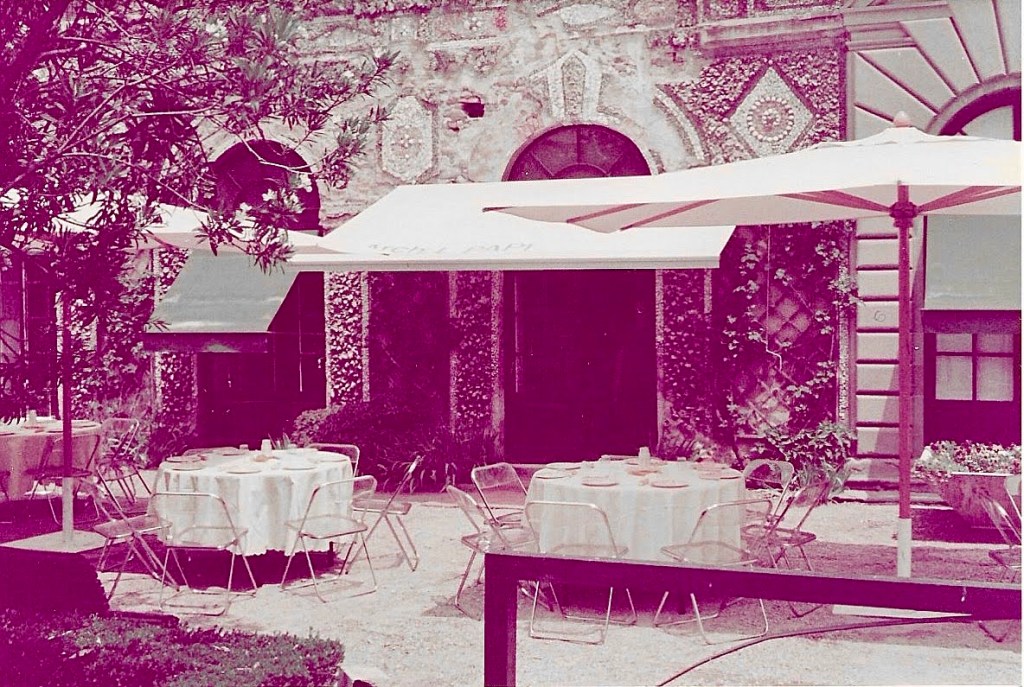
My initial introduction to the Papi family was mid-May in the conference room—the grotto-like walls plastered and inlaid with pebbles, shells, and stone chips. Scalloped niches at regular intervals some with partial statuary and others bare and a bit decrepit. Within these 18th century walls we gathered at the decidedly 20th century table designed by the man who was to be my charge and companion for the coming months. The imposing table was pale travertine routed with a soft undulating wave design filled with lapis lazuli. The result was modern and classical simultaneously with an organic simplicity and beauty that contrasted with its historic setting without detracting from it.
In the forty years in between then and now I have returned to Florence more than twenty times. It is a destination that is both comfortable like a well-worn garment and yet never fails to deliver new and breathtaking moments and memories. Not least of those memories are those centered on a period of time during the height of summer of 1983 when I was sent to spend time living at La Limonaia.
In all honesty, it was at that period referred to as Lo Studio. It had been converted at some point in the preceding decade or so to house the architectural studio of my employer. The row of French doors opened onto a series of offices, work spaces, and the aforementioned conference room. The primary entry was in the center, this was the only section that was double height. While the lower level held the reception desk of the faithful and dedicated Mariolina, a narrow staircase to the rear led to a small apartment space consisting of a live-work space, the “l’angolo cottura”, a small bath with shower and a bedroom.
None of this was by any standard to be considered luxurious, functional yes, luxurious, definitely not. It was, however, a wonderful, albeit brief taste of autonomy and independence. In my description I neglected to mention the small but gloriously sunny terrace just off the bedroom. I think this 150sf patch of tile pavement was my favorite thing about Lo Studio—or for the sake of this story La Limonaia. While my memory of the time is a bit fuzzy, for two weeks or so I was left to my own devices without the routine or duties that shaped every day working with Lorenzo Papi. My days were undoubtedly spent reading and sunbathing on that terrace, window shopping in the center, and likely freeloading at mealtime from my friends Monica and Bruno.
Fast forward forty years. I am retired now and plotting what I hope will be my fourth extended visit to Florence. I am doing preliminary research on short term rentals and exploring what neighborhoods might make the most sense for me. As a result, my nose has been to the map of Florence more than usual. My virtual tour has unleashed a flood of memories from various visits over the span of a lifetime. Seeing the garden of the Palazzo Capponi on Google Maps started me wondering about the status of Lo Studio—l’ex-Limonaia.
I am not sure exactly what my search terms were, but I was nevertheless pleasantly surprised to see a New York Times article from 2014 titled “Italian Villa With a Scent of Lemon”. Along with the article was a photo of a very familiar facade from my distant past. It seems that in 2010 an American couple bought La Limonaia and created an almost 3500 sf five bedroom home for their family. By the time the article appeared in 2014 the renovated Limonaia was on the market for almost $5M. The charming sunny terrace of my memories was referenced, “Separate stairs within the central tower lead to the master suite, which has access to a stone-flagged roof terrace overlooking the grounds of the Four Seasons and with views of the city’s famous Duomo.”
We’ve all heard the old adage, “when life gives you lemons, make lemonade”. It’s clear to me that that American couple took the adage to heart. They renovated an historical space to the highest standard while preserving its protected features. The $5M price tag for their efforts in most cultures would be good for a significant amount of lemonade. Photos of the renovated space can be seen at: KB Walsh Design Ltd.
Even with all of its high end finishes and stylish decor, there is a part of me, the 24 year old me at my core, that knows that the new and improved Limonaia cannot compare to the less refined, functionality of the Limonaia of my memories. The misty water-colored memories of my misspent youth in Florence bring me an undefinable pleasure whose value is mine alone. While the adage recommends making lemonade, I think I will take another tact and make limoncello!
The Last Hurrah: Weekend in Paris
By late August of 1983, the duration of my return ticket to the US was fast approaching and it was clear to me that role with the Papi family, while interesting, was not a career path. I discussed things with Donatella and let her know that I would be leaving. We fixed a date and at that time I moved back to Florence and stayed with Monica and Bruno until my return flight at the end of September.
I hadn’t been back in Florence long when Donatella reached out to me to ask a favor. Would I consider traveling to Paris for a long weekend with Leonardo? To reward him for working hard in summer school to improve his grades, she had planned to treat him to a weekend in Paris before school started again. With the situation with Lorenzo being particularly challenging and in need of her direct involvement, she could not get away. Initial plans for a favorite older cousin to accompany him had fallen through. I would be doing her a great service if I were to travel to Paris, all expenses paid, to chaperone her big, affable sixteen year old son.
I agreed to the proposal. It included roundtrip airfare from Pisa to Paris, the hotel where we would share a room, meal expenses as well as expenses for other sundries costs. She had arranged certain tours and excursions in advance, I just needed to be the responsible one to get us to the right place at the right time.
As background, my only previous visit to Paris had been three years earlier during the extended spring of my year abroad. I traveled solo and on a very limited budget. Arriving in Paris by train from London, I found a very economical hotel in the Latin Quarter. At the exchange rate in March of 1980, four francs to a dollar, my 32 franc daily rate was the equivalent of $8 per night! It was, as I recall, a quintessential 19th century French hotel. There was a reception desk on the first level about the size of a broom closet. My room was up multiple flights of small, narrow stairs and while the room had a sink in it, the shower/bath and toilet were both separate and shared. If you have ever seen the movie Victor/Victoria, you will have some idea of the standard of hotel I stayed in on that first visit to the French capital. I think my visit was a four day stay and while I managed with the sink in the room and the shower down the hall, I did not immediately find the toilet. For the most part, this was managed with well-timed meals out and visits to monuments and museums to accommodate my quotidian regularity. I think it was on my third day that I did finally find the toilet, hidden successfully behind a flush mounted wall panel door on one of the hairpin turn landings of the staircase, almost imperceivable to the human eye. My timing was good as I was feeling the need and was not in a museum or a cafe at the time. While finding the toilet cabinet was a minor victory, I like to accentuate the positive when I can, finding the light switch continued to vex me. After what seemed like an undue amount of time, I determined that I would be able to manage in the dark. I left the door ajar just enough to facilitate my arrangements before closing it to proceed in the dark. Imagine my surprise when the lights came on just as the door closed! Reverse refrigerator technology in bathroom design! Let it suffice to say that relief was felt in myriad ways.
So, with that inauspicious introduction to Paris, I was more than happy to accept an opportunity to see another side of that city’s hospitality industry. While I do not recall the exact location or hotel name, it was in fact, a large, rather gracious hotel on one of the broad, elegant avenues and the room was graciously spacious with two double beds and most importantly the now ubiquitous en suite bathroom.
As I recall, while we were instructed to visit the Louvre, I believe we may have simply followed one of the standard tours to see the highlights. I think that Leonardo was excited to find some of the pieces in the Louvre that came from his great-grandfather’s collection. I think that one would be hard pressed in any museum to not find a piece of art with the Contini-Bonacossi provenance.
We did have pre-booked and scheduled tours of both Versailles as well as one of those evening dinner cruises on the Seine. There were several times when I had to ask people if they spoke English so that I ask in English where the Italian tour started. This resulted in some French eye rolling, or at least I hope it did. At least during our guided tour of Versaille, I was able to follow along as the French tour guide gave the tour in Italian. Of course this was at the end of my year living in Italy and my comprehension was maybe as good as it would ever be.
The dinner cruise on the Seine was something that I never would have been able to do during my 32 franc per night stay. While I do not recall much about the quality of the food or wine served, the views and scenery were absolutely stunning. It was a lovely autumn evening with the light faded and the illumination coming from the striking grand buildings and palais that border the Seine. While I have returned to Paris several times since, I have yet to do this again–perhaps the next time!
From my perspective the weekend went off without a hitch and was a great success. Of course, I never heard anything to the contrary from Donatella, and I am not sure what news or reviews were reported by my sixteen year old travel charge.
The End
In the final days of September 1983, my summer adventure ended with the season and my year in Italy concluded as I caught my return flight from Rome to Seattle. By December 1983 I had secured a job and had moved into my first apartment on Seattle’s Capitol Hill. Life moved on, and so did I, but the memories of that summer and the people I shared it with have long lingered in the recesses of my memory. I hope that in some capacity, my recounting of this time, and the descriptions of the people and events, will somehow conclude the tales of my misspent youth in Italy.
 THTooLongDon'tRead
Leave a comment